Description
Product description
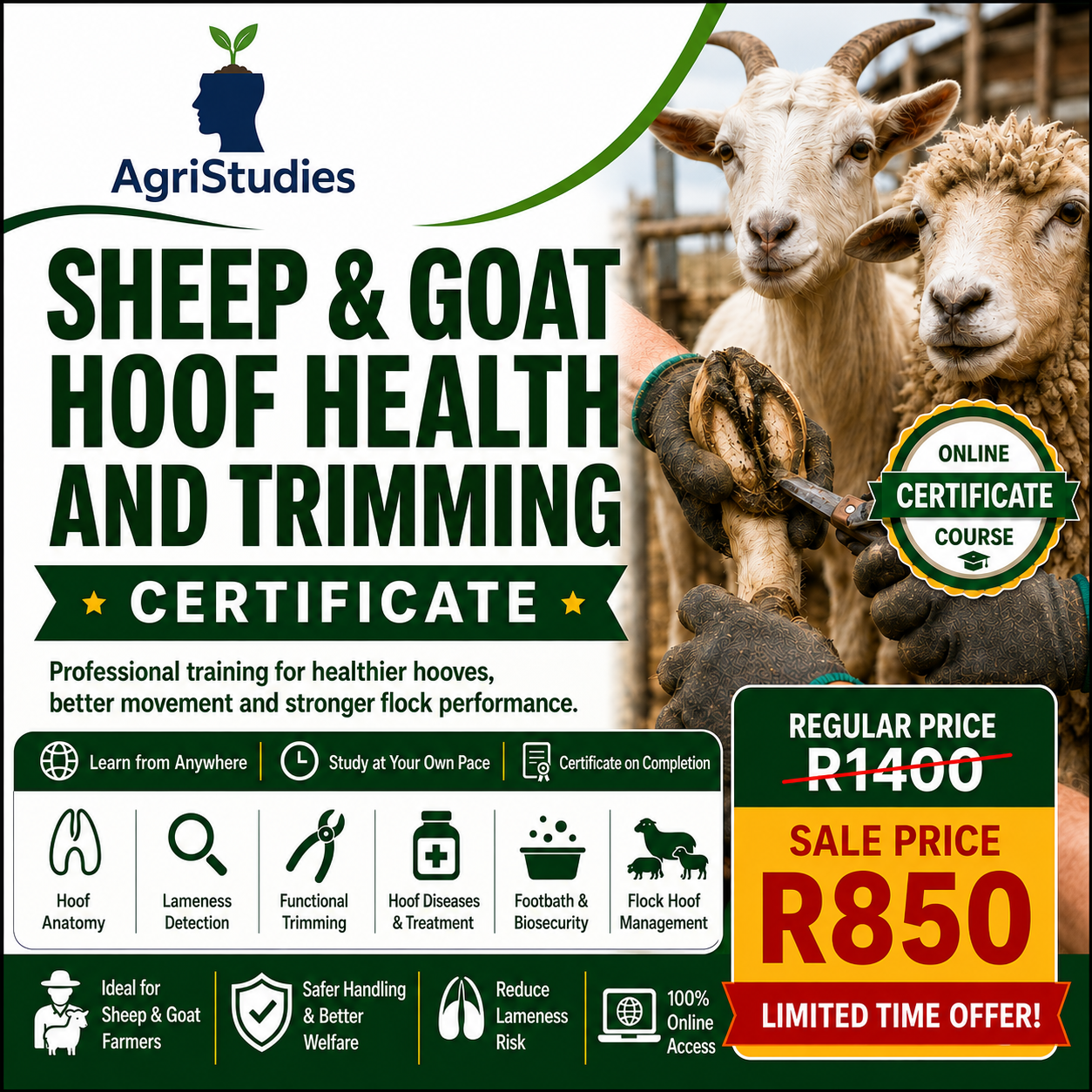
Learn the practical skills behind healthier sheep and goats, better movement, reduced lameness risk and stronger flock performance.
Hoof problems can affect animal welfare, feeding, growth, milk production, breeding performance, labour use and long-term farm profitability. The Sheep and Goat Hoof Health and Trimming Certificate is designed to help farmers, farm workers, smallholders and livestock service providers understand how to identify hoof problems early, trim hooves correctly and support better hoof health management.
This course covers sheep and goat hoof anatomy, lameness detection, common hoof diseases and disorders, safe handling and restraint, hoof trimming tools, functional trimming, corrective hoof care, footbath management, biosecurity, flock hoof health planning and the basics of starting a professional hoof care service.
Learners will gain a clear understanding of when trimming is needed, how to trim conservatively, how to avoid common mistakes, when veterinary involvement is required and how to manage hoof health as part of a wider flock or herd health programme.
This course is ideal for sheep farmers, goat farmers, smallholders, farm workers, flock managers, animal health workers, agricultural students, livestock technicians and anyone interested in offering a professional hoof care service.
Study online, at your own pace, and complete the course to earn your AgriStudies certificate.
AGRISETA Accreditation is under the name Nosa Agricultural Services.
Service provider code AGRI/c prov/0459/13
Disclaimer:
Disclaimer
The Sheep and Goat Hoof Health and Trimming Certificate is an educational course designed to provide practical knowledge about hoof health, lameness recognition, safe handling, basic hoof trimming principles, prevention, records and professional hoof care service practices.
This course is not a veterinary qualification and does not authorise learners to diagnose disease, prescribe medication, perform veterinary procedures or replace the role of a qualified veterinarian. Serious, painful, infected, unusual, recurring or non-responsive hoof conditions should be referred to a veterinarian or appropriate animal health professional.
Learners are responsible for applying the information in this course safely, responsibly and within their own level of training, experience and local legal requirements. Hoof trimming and animal handling involve risk to both animals and people. Incorrect restraint, poor tool use, aggressive trimming, over-trimming or failure to recognise serious disease can cause pain, injury, bleeding, infection, stress or worsening lameness.
The course encourages conservative hoof care, careful observation, good records, safe handling, biosecurity and veterinary referral where needed. Learners should not attempt advanced corrective work, treatment of severe infection, management of exposed sensitive tissue, use of prescription medicines or complex hoof disease control without suitable training and veterinary guidance.
Farm conditions, animal health status, hoof disease risks, handling facilities, weather, nutrition, housing and local regulations may differ between farms and regions. The information in this course should therefore be used as general educational guidance and adapted responsibly to the specific farm situation.
AgriStudies does not accept responsibility for injury, loss, animal harm, poor outcomes, disease spread, legal consequences or business losses resulting from incorrect application of the course material, unsafe handling, improper trimming, failure to seek veterinary care or actions taken outside the learner’s competence.
By enrolling in and using this course, learners acknowledge that sheep and goat hoof care must always be performed with animal welfare, worker safety, biosecurity, legal compliance and professional judgement as the priority.
Course Overview
Course overview
The Sheep and Goat Hoof Health and Trimming Certificate is a practical online training course designed to help learners understand, prevent, identify and manage hoof problems in sheep and goats.
Hoof health is directly linked to animal welfare, movement, feeding, growth, milk production, breeding performance and long-term flock or herd productivity. When sheep or goats develop painful feet, they may move less, eat less, lose condition, fall behind the group, nurse young less effectively and become more vulnerable to chronic health and welfare problems.
This course teaches learners how to recognise hoof problems early, understand the basic anatomy of the hoof, identify common hoof diseases and disorders, handle animals safely, use trimming tools correctly and apply conservative hoof trimming principles. It also explains when trimming is needed, when trimming should be avoided, when follow-up care is required and when veterinary involvement is necessary.
The course is designed for real farm application. Lessons focus on practical hoof care decisions that farmers, farm workers, smallholders, livestock technicians and aspiring hoof trimmers may face during daily animal observation, routine handling, trimming sessions, lameness cases, disease outbreaks and flock hoof health planning.
Learners are guided through the full hoof care process, from understanding why hoof health matters to building a preventative hoof health programme. The course also includes modules on tools, equipment, safe restraint, functional trimming, corrective care, biosecurity, record keeping, footbath management and professional service delivery.
The training emphasises responsible hoof care. Learners are taught to trim only what is necessary, protect sensitive tissue, avoid over-trimming, recognise signs of pain and infection, keep accurate records and refer serious or medical cases to a veterinarian. The course does not promote aggressive trimming or replacing veterinary care with routine hoof work.
Course details
- Course name: Sheep and Goat Hoof Health and Trimming Certificate.
- Course type: Online certificate course.
- Study method: Self-paced online learning.
- Estimated completion time: 6 to 8 hours.
- Course level: Practical vocational training for livestock and farm workers.
- Number of modules: 10 modules.
- Lesson count: More than 80 focused lessons.
- Assessment: Module quizzes and a final certification quiz.
- Certificate: AgriStudies certificate issued after successful completion.
Main course areas
- Introduction to sheep and goat hoof health.
- Hoof anatomy, hoof growth, weight bearing and natural wear.
- Lameness detection, mobility scoring and early intervention.
- Common hoof diseases and hoof disorders.
- Hoof trimming tools, treatment products and equipment maintenance.
- Safe sheep and goat handling and restraint.
- Functional hoof trimming methods.
- Corrective and therapeutic hoof care principles.
- Flock hoof health management, prevention, biosecurity and records.
- Starting and growing a professional hoof care service.
Practical focus
This course focuses on practical decision-making rather than theory alone. Learners are taught how hoof health problems develop, how to observe animals correctly, how to decide whether trimming is needed, how to prepare hooves for inspection, how to trim conservatively and how to support recovery through follow-up and management changes.
The course also covers common farm-level risk factors such as wet bedding, poor drainage, muddy gateways, soft ground, hard surfaces, poor handling systems, nutrition problems, infectious disease pressure and lack of records. Learners are shown how these factors influence hoof health and how better planning can reduce lameness risk.
Assessment and certificate
Learners complete quizzes during the course to check their understanding of important hoof health concepts. The final assessment tests foundation knowledge, technical understanding, practical application and professional judgement.
After successfully completing the course and assessment requirements, learners receive an AgriStudies certificate confirming completion of the Sheep and Goat Hoof Health and Trimming Certificate.
Learning outcome
By the end of the course, learners should be able to recognise common hoof problems, understand when trimming is needed, apply safe and conservative trimming principles, support early lameness detection, manage hoof health records, reduce hoof disease risk and make responsible decisions about follow-up care and veterinary referral.
What You Will Learn
What you will learn
The Sheep and Goat Hoof Health and Trimming Certificate gives learners practical, farm-focused knowledge for understanding hoof health, recognising lameness, trimming hooves correctly and supporting better flock and herd hoof management.
By completing this course, learners will build a strong understanding of how hoof problems affect animal welfare, movement, feeding, production and long-term farm performance. The course also teaches learners how to work safely, use tools correctly, avoid common trimming mistakes and recognise cases that require veterinary involvement.
Why hoof health is important for sheep and goat welfare, comfort, movement and productivity.
How lameness affects feeding, growth, breeding, milk production, labour use and flock performance.
The basic external and internal anatomy of sheep and goat hooves.
How hoof growth, natural wear, terrain, housing and nutrition affect hoof condition.
The key differences between sheep hooves, goat hooves and cattle hooves.
How to recognise early signs of lameness, pain, altered posture and abnormal movement.
How to use mobility observation and simple records to monitor hoof health over time.
How to identify common hoof diseases and disorders such as foot rot, scald, shelly hoof, abscesses, white line separation, toe granulomas, overgrown hooves and laminitis.
Which hoof problems can be managed with routine hoof care and which require veterinary assessment.
How to select and use hoof shears, trimmers, knives, rasps, cleaning tools and personal protective equipment.
How to clean, disinfect, maintain and store hoof care equipment to support biosecurity and tool safety.
How to catch, move and restrain sheep and goats safely for hoof inspection and trimming.
How to protect both the animal and the operator during hoof care work.
When hoof trimming is needed and when hooves should be left alone.
How to trim the hoof wall conservatively while avoiding sensitive tissue, bleeding and over-trimming.
How to balance the sole and claws to support normal weight bearing and movement.
How to avoid common trimming mistakes that can cause pain, weakness or future hoof problems.
How to assess the animal after trimming for comfort, balance, bleeding and follow-up needs.
When corrective trimming may be needed for overgrowth, imbalance, deformity or pressure points.
How to manage hoof care support for foot rot, scald, abscesses, shelly hoof, white line separation and toe granulomas within safe professional limits.
Why follow-up care is important after corrective or therapeutic hoof work.
How to build preventative hoof care programmes for sheep and goat flocks or herds.
How to plan hoof trimming schedules based on hoof growth, wear, season, housing, terrain and disease risk.
How housing, bedding, drainage, pasture, mud, nutrition and biosecurity affect hoof health.
How footbaths should be planned, managed, recorded and used responsibly as part of a wider hoof health programme.
How to manage chronic cases, repeated lameness and culling decisions responsibly.
How to keep useful hoof health records and use them to improve flock or herd management.
How to build a practical flock hoof health plan for prevention, early detection, treatment, follow-up and review.
How to understand the professional standards expected from a hoof care provider.
How to price hoof care services fairly by considering time, travel, tools, cleaning, records, risk and profit.
How to build strong farmer relationships through clear communication, honest advice and reliable service.
How to manage equipment costs, scheduling, record keeping, reports and marketing for a hoof care service.
How to grow a professional hoof care business while protecting animal welfare, biosecurity and service quality.
This course is designed to help learners move beyond basic hoof trimming and understand hoof care as part of a complete animal welfare, flock health and farm management system.
Course Structure
Course structure
The Sheep and Goat Hoof Health and Trimming Certificate is a structured online course designed to take learners from basic hoof health knowledge through to practical trimming, disease recognition, flock hoof health management and professional hoof care service delivery.
The course is divided into 10 modules with more than 80 focused lessons. Each module builds on the previous one so that learners first understand hoof health, anatomy, lameness and disease before moving into tools, handling, trimming, corrective care, prevention planning and business development.
Estimated completion time
Estimated study time: 6 to 8 hours.
Course format: Online and self-paced.
Access: Learners can study from a phone, tablet or computer.
Assessment format: Module quizzes and a final certification quiz.
Certification: Learners receive an AgriStudies certificate after successful completion.
Module 1: Introduction to sheep and goat hoof health
This module introduces learners to the importance of hoof health in sheep and goats. It explains why hoof problems affect animal welfare, production, movement and farm profitability. Learners also begin to understand the role and responsibility of the hoof trimmer.
1.1 Why hoof health matters.
1.2 The cost of lameness.
1.3 Hoof health and animal welfare.
1.4 Sheep and goat production systems.
1.5 The role of the hoof trimmer.
1.6 Differences between sheep, goats and cattle.
Module 2: Understanding sheep and goat hoof anatomy
This module explains the external and internal structures of the sheep and goat hoof. Learners study how hooves grow, how weight is carried, how movement affects hoof wear and why sheep and goat hooves must be handled differently from cattle hooves.
2.1 External anatomy of the hoof.
2.2 Internal hoof structures.
2.3 Hoof growth and natural wear.
2.4 Weight bearing and movement.
2.5 Differences between sheep and goat hooves.
2.6 Hoof function and mobility.
Module 3: Identifying lameness and mobility problems
This module teaches learners how to recognise lameness and mobility problems early. It covers movement observation, posture, pain indicators, mobility scoring and the importance of recording lameness cases before problems become severe.
3.1 What is lameness?
3.2 Common signs of lameness.
3.3 Mobility scoring in sheep and goats.
3.4 Observing movement and posture.
3.5 Early detection and intervention.
3.6 Recording lameness cases.
Module 4: Common hoof diseases and disorders
This module gives learners a practical understanding of common hoof diseases and disorders in sheep and goats. Learners are taught how to recognise important hoof conditions, understand risk factors and identify when veterinary involvement is required.
4.1 Foot rot.
4.2 Scald and interdigital dermatitis.
4.3 Contagious ovine digital dermatitis.
4.4 Shelly hoof.
4.5 Hoof abscesses.
4.6 White line separation.
4.7 Toe granuloma.
4.8 Overgrown hooves.
4.9 Laminitis in small ruminants.
4.10 Injuries and foreign objects.
Module 5: Hoof trimming tools, equipment and treatment products
This module introduces the tools and equipment used in sheep and goat hoof care. Learners study how to choose, use, clean, maintain and store equipment safely. The module also covers treatment products, footbath equipment and personal protective equipment.
5.1 Hoof shears and trimmers.
5.2 Hoof knives.
5.3 Hoof rasps and files.
5.4 Cleaning equipment and hoof preparation tools.
5.5 Cleaning solutions and antiseptics.
5.6 Hoof sprays, dressings and treatment products.
5.7 Footbath equipment and treatment systems.
5.8 Personal protective equipment.
5.9 Equipment maintenance.
Module 6: Safe animal handling and restraint
This module focuses on safe handling of sheep and goats during hoof inspection and trimming. Learners study animal behaviour, catching, movement, restraint, handling facilities, operator safety and emergency procedures.
6.1 Understanding sheep and goat behaviour.
6.2 Safe catching and movement.
6.3 Restraining sheep correctly.
6.4 Restraining goats correctly.
6.5 Working with handling facilities.
6.6 Operator safety.
6.7 Emergency procedures.
Module 7: Functional hoof trimming
This module teaches the principles of functional hoof trimming. Learners study when trimming is needed, how to trim the hoof wall, how to balance the claws, how to avoid common mistakes and how to assess the animal after trimming.
7.1 Purpose of functional trimming.
7.2 When trimming is needed.
7.3 Step-by-step trimming method.
7.4 Trimming the hoof wall.
7.5 Balancing the sole and claws.
7.6 Avoiding common trimming mistakes.
7.7 Trimming goats versus sheep.
7.8 Post-trimming assessment.
Module 8: Corrective and therapeutic hoof care
This module covers hoof care for more complex cases. Learners study when corrective trimming is needed, how to relieve pressure points, how to support common hoof conditions and how to work within professional limits when veterinary care is required.
8.1 When corrective trimming is needed.
8.2 Relieving pressure points.
8.3 Managing foot rot cases.
8.4 Managing scald and interdigital irritation.
8.5 Managing hoof abscesses.
8.6 Managing shelly hoof and white line separation.
8.7 Managing toe granulomas.
8.8 Medical management of hoof conditions.
8.9 Working with veterinarians.
8.10 Follow-up care.
Module 9: Flock hoof health management
This module teaches learners how to manage hoof health at flock or herd level. It covers prevention programmes, trimming schedules, footbath management, housing, bedding, drainage, pasture, nutrition, biosecurity, culling decisions, records and hoof health planning.
9.1 Preventative hoof care programmes.
9.2 Hoof trimming schedules.
9.3 Footbath management.
9.4 Housing, bedding and drainage.
9.5 Pasture and terrain management.
9.6 Nutrition and hoof health.
9.7 Biosecurity and disease prevention.
9.8 Footbath design and chemical management.
9.9 Culling and chronic cases.
9.10 Record keeping systems.
9.11 Building a flock hoof health plan.
Module 10: Starting a professional hoof care service
This module introduces the business and professional standards needed to offer hoof care as a service. Learners study pricing, farmer relationships, equipment costs, scheduling, reports, marketing and how to grow a hoof care business responsibly.
10.1 Professional standards.
10.2 Pricing your services.
10.3 Building farmer relationships.
10.4 Managing equipment costs.
10.5 Scheduling farm visits.
10.6 Record keeping and reporting.
10.7 Marketing a hoof care service.
10.8 Growing a professional hoof care business.
Assessment and certification
The course includes module quizzes to help learners check their understanding throughout the programme. These quizzes reinforce key terminology, technical concepts, practical decision-making and animal welfare principles.
Learners complete quizzes during the course to confirm understanding of each main topic area.
The final quiz assesses foundation knowledge, technical understanding, practical application and professional judgement.
The final assessment includes questions on anatomy, lameness detection, hoof diseases, safe handling, trimming principles, corrective care, flock management and professional service delivery.
Learners who successfully complete the course receive an AgriStudies certificate of completion.
Learning outcome
By the end of the course, learners should understand how to recognise hoof problems, trim sheep and goat hooves conservatively, support early lameness detection, use tools safely, manage common hoof risks, apply basic prevention principles and know when veterinary involvement is needed.
Who Should Enroll
Who should enroll
The Sheep and Goat Hoof Health and Trimming Certificate is designed for anyone who works with sheep or goats and wants to improve hoof health, reduce lameness risk and support better animal welfare.
This course is suitable for learners who want practical, farm-focused knowledge that can be applied in real sheep and goat production systems.
Sheep farmers who want to improve flock mobility and reduce hoof-related losses.
Goat farmers who need practical hoof care knowledge for meat, dairy or breeding herds.
Smallholders who keep sheep or goats and want to manage hoof problems more confidently.
Farm workers responsible for observing animals, assisting with handling or supporting routine hoof care.
Flock managers and herd supervisors who need to plan hoof health checks, records and follow-up care.
Animal health workers who want a stronger understanding of hoof problems in small ruminants.
Veterinary assistants who support hoof inspections, treatment preparation and farmer communication.
Agricultural students who want practical livestock health knowledge for sheep and goat production.
Livestock technicians and consultants who advise farmers on animal health, welfare and management.
Aspiring hoof trimmers who want to start building a professional sheep and goat hoof care service.
The course is also useful for anyone who wants to understand when trimming is needed, how to recognise hoof problems early, how to avoid common trimming mistakes and when veterinary involvement is required.





Reviews
There are no reviews yet.