Description
Backyard Regenerative Aquaculture Certification
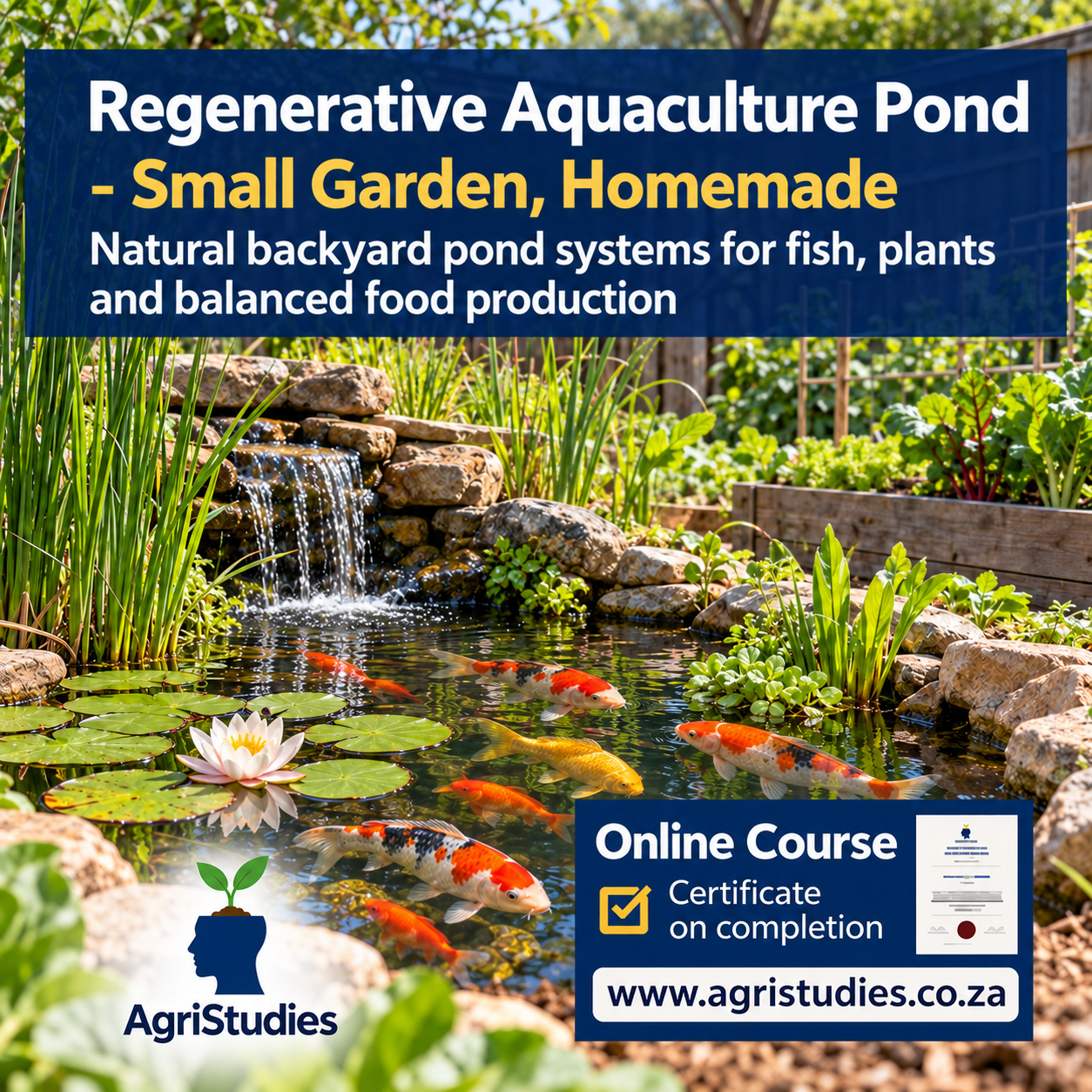
Backyard Regenerative Aquaculture Certification is a comprehensive online course designed to teach learners how to plan, build, and manage a small homemade regenerative aquaculture pond for food production, biodiversity, and long-term sustainability.
The course goes beyond simply keeping fish in a pond. Learners are introduced to the pond as a complete living ecosystem where fish, aquatic plants, beneficial microorganisms, insects, wildlife, water quality, nutrient cycling, and natural food production all work together.
Throughout the course, learners will explore practical pond design and construction, water quality management, biological filtration, aquatic plant systems, fish selection and stocking, breeding, natural food webs, biodiversity, sustainable harvesting, and the integration of the pond with gardens and wider circular food systems.
A major focus is placed on creating a productive backyard system that remains manageable over time. Learners will understand how to control fish biomass, prevent nutrient overload, manage algae and organic matter, maintain oxygen and water stability, harvest plants and fish sustainably, and use pond-derived resources such as nutrient-rich water, aquatic plant biomass, and suitable sediment more effectively.
The course also covers long-term pond development, seasonal management, population control, ecosystem stress, resilience, and future expansion.
What You Will Learn
- How regenerative aquaculture differs from conventional fish farming
- How to plan and design a small backyard aquaculture pond
- Pond construction methods, liners, substrates, edges, and habitat zones
- Water quality, oxygen, temperature, pH, and the nitrogen cycle
- Beneficial bacteria, biofilms, and biological filtration
- Aquatic plants and natural nutrient management
- Algae, plankton, insects, duckweed, and natural fish foods
- Fish species selection, stocking rates, and acclimation
- Breeding, forage fish, and multi-species systems
- Pond biodiversity and beneficial wildlife
- Sustainable fish harvesting and population management
- Preventing algae blooms and recognising ecosystem stress
- Seasonal pond maintenance and natural corrective techniques
- Using pond nutrients, plants, water, and organic resources productively
- Integrating the pond with gardens and circular food systems
- Long-term pond development, expansion, and stewardship
This course is suitable for smallholders, homesteaders, backyard food growers, hobby farmers, gardeners, sustainability enthusiasts, and anyone interested in producing fish and food through a more natural, regenerative pond system.
Estimated Course Duration: ±25 Hours
Recommended Completion Time: 3–4 Weeks
AGRISETA Accreditation is under the name Nosa Agricultural Services.
Service provider code AGRI/c prov/0459/13
Disclaimer:
Disclaimer
The Backyard Regenerative Aquaculture Certification is provided for educational and informational purposes only. It is intended to give learners a practical understanding of regenerative aquaculture, pond management, fish care, water quality, aquatic plants, nutrient cycling, harvesting, and long-term system development.
Aquaculture conditions vary according to fish species, climate, water source, pond design, stocking density, feeding practices, equipment, and local environmental conditions. Learners should adapt the information to their own circumstances and monitor their systems carefully.
This course does not replace professional veterinary, aquaculture, engineering, environmental, water-quality, or legal advice where such advice is required.
Learners are responsible for checking and complying with applicable local laws, permits, environmental regulations, water-use requirements, biosecurity measures, animal-welfare requirements, and rules relating to fish species, aquatic plants, breeding, transport, harvesting, and release.
No guarantee is made regarding fish growth, survival, breeding success, harvest quantities, financial returns, water quality, pond performance, or specific production outcomes.
By applying the information in this course, learners accept responsibility for their own pond planning, construction, stocking, maintenance, management decisions, and use of pond-derived resources.
Course Overview
The Backyard Regenerative Aquaculture Certification is a comprehensive self-paced course designed to teach learners how to plan, build, manage, and develop a small homemade aquaculture pond as a productive living ecosystem.
The course explores how fish, aquatic plants, beneficial microorganisms, algae, insects, sediment, organic matter, water quality, and natural food sources work together within one connected pond system.
Learners begin with the foundations of regenerative aquaculture and progress through:
- Pond ecosystem functions and natural food webs
- Site selection, planning, and pond design
- Pond construction and installation
- Water quality and biological filtration
- Aquatic plants and natural food production
- Fish selection, stocking, breeding, and biodiversity
- Pond management and ecosystem balance
- Sustainable harvesting and population control
- Garden integration and circular food systems
- Long-term pond development, expansion, and stewardship
A strong focus is placed on understanding the balance between fish biomass, feed input, oxygen demand, plant growth, nutrient cycling, sediment, and biological carrying capacity.
Learners will also explore how to recognise early signs of ecosystem stress, prevent algae problems, manage seasonal changes, and apply natural corrective techniques before small issues develop into major pond problems.
The course also covers the productive use of pond-derived resources such as aquatic plant biomass, nutrient-rich water, and suitable sediment, helping learners understand how aquaculture can be integrated with gardens, composting, irrigation, and wider food-production systems.
By the end of the course, learners will have a practical understanding of how to create and manage a resilient backyard aquaculture pond that supports fish production, biodiversity, nutrient recovery, garden productivity, and long-term ecological stability.
What You Will Learn
By the end of the Backyard Regenerative Aquaculture Certification, learners will understand how to plan, build, manage, and maintain a small homemade aquaculture pond as a productive living ecosystem.
- Understand the principles of regenerative aquaculture and how a living pond system functions
- Understand natural food webs, nutrient cycling, and ecological balance
- Recognise the roles of fish, aquatic plants, microorganisms, algae, insects, and decomposers
- Understand the difference between conventional fish farming and regenerative aquaculture
- Plan a pond according to available space, sunlight, shade, soil, water access, and production goals
- Choose suitable pond shapes, sizes, depths, and functional zones
- Develop a safe and practical pond construction plan
- Select suitable pond types, liners, substrates, rocks, edges, and habitat structures
- Prepare, excavate, fill, and condition a pond correctly
- Understand oxygen, temperature, pH, alkalinity, and essential water chemistry
- Understand the nitrogen cycle and natural biological filtration
- Learn how beneficial bacteria, microorganisms, and biofilms support pond health
- Monitor water quality and maintain long-term water stability
- Select floating, submerged, and marginal aquatic plants
- Manage plant growth and pond coverage effectively
- Understand the role of algae, plankton, insects, duckweed, and natural fish foods
- Develop a productive year-round natural food system
- Select suitable fish species for small ponds
- Manage stocking rates, fish biomass, carrying capacity, and acclimation
- Understand breeding, forage fish, and sustainable multi-species systems
- Support beneficial wildlife and pond biodiversity
- Manage fish, plants, nutrients, organic matter, and sediment together
- Prevent excessive algae blooms and common water-quality problems
- Recognise early signs of ecosystem stress and imbalance
- Adjust feeding, aeration, plant management, and maintenance according to seasonal changes
- Apply natural corrective techniques to restore pond balance
- Harvest fish sustainably and manage pond populations
- Use aquatic plants, pond water, sediment, and other organic resources productively
- Integrate the pond with gardens, irrigation, and compost systems
- Understand circular food-production systems and nutrient reuse
- Plan for long-term pond development, expansion, and stewardship
- Build a more resilient, manageable, and sustainable backyard aquaculture system
Course Structure
The Backyard Regenerative Aquaculture Certification is divided into 9 comprehensive modules and 36 detailed lessons, taking learners step by step from the foundations of regenerative aquaculture through to pond construction, fish management, harvesting, garden integration, and long-term stewardship.
Module 1: Foundations of Regenerative Aquaculture
- Introduction to regenerative aquaculture and living pond systems
- Closed-loop ecosystems and regeneration principles
- Natural food webs and ecosystem functions
- Conventional fish farming vs regenerative aquaculture
- Benefits of backyard food-producing ponds
- Ecological resilience and long-term sustainability
- Planning a legacy pond
Module 2: Understanding Pond Ecosystems
- Components of a healthy pond ecosystem
- Producers, consumers, decomposers, and natural food webs
- Energy flow, nutrient cycling, and ecological balance
- Pond maturity, carrying capacity, and signs of a healthy ecosystem
Module 3: Site Selection, Planning, and Pond Design
- Defining pond goals and available space
- Sunlight, shade, soil, water access, and site conditions
- Pond shape, size, depth, and functional zones
- Developing a safe and practical construction plan
Module 4: Pond Construction and Installation
- Choosing the right pond type and construction method
- Site preparation, excavation, and pond formation
- Liners, edges, substrates, rocks, and habitat structures
- Filling, conditioning, and preparing the pond for life
Module 5: Water Quality and Biological Processes
- Oxygen, temperature, pH, and essential water chemistry
- The nitrogen cycle and natural biological filtration
- Beneficial bacteria, microorganisms, and biofilms
- Monitoring and maintaining long-term water stability
Module 6: Aquatic Plants and Natural Food Production
- Floating, submerged, and marginal plants
- Managing aquatic plant growth and pond coverage
- Algae, plankton, insects, duckweed, and natural fish foods
- Creating a productive year-round natural food system
Module 7: Fish Selection, Stocking, and Biodiversity
- Selecting suitable fish species
- Stocking rates, carrying capacity, and fish acclimation
- Breeding, forage fish, and sustainable multi-species systems
- Supporting beneficial wildlife and pond biodiversity
Module 8: Pond Management and Ecosystem Balance
- Managing fish, plants, nutrients, and organic matter
- Preventing algae blooms and water-quality problems
- Recognising signs of ecosystem stress and imbalance
- Seasonal maintenance and natural corrective techniques
Module 9: Harvesting, Circular Systems, and Long-Term Sustainability
- Sustainable fish harvesting and population management
- Using aquatic plants, pond nutrients, and organic resources
- Integrating the pond with the garden and circular food systems
- Long-term pond development, expansion, and future stewardship
Course Includes
- 9 comprehensive modules
- 36 detailed lessons
- Module quizzes throughout the course
- 50-question final examination
- Approximately 25 hours of study content
- Recommended completion time: 3–5 weeks
- Fully self-paced online learning
Who Should Enroll
This course is suitable for anyone interested in creating, managing, or improving a small backyard aquaculture pond as a productive and sustainable food system.
- Smallholders and homesteaders who want to produce fish at home
- Backyard food growers interested in sustainable food production
- Hobby farmers looking to develop a small-scale aquaculture system
- Gardeners who want to integrate fish, aquatic plants, and nutrient cycling into their garden
- Beginners who want to learn the fundamentals of pond design, construction, stocking, and water management
- Existing pond owners who want to improve the health, balance, and productivity of their pond
- People interested in regenerative agriculture and natural food-production systems
- Sustainability enthusiasts interested in biodiversity, nutrient recycling, and water reuse
- Learners interested in fish breeding, stocking rates, carrying capacity, and population management
- People interested in aquatic plants, duckweed, algae, plankton, insects, and natural fish foods
- Home food producers who want to connect aquaculture with composting, irrigation, and vegetable production
- Anyone wanting to build a long-term backyard pond system that supports fish production, biodiversity, and ecological resilience
No previous aquaculture experience is required. The course starts with the basics and progresses through pond design, construction, water quality, fish management, harvesting, and long-term stewardship.
Course Overview
The Backyard Regenerative Aquaculture Certification is a comprehensive self-paced course designed to teach learners how to plan, build, manage, and develop a small homemade aquaculture pond as a productive living ecosystem.
The course explores how fish, aquatic plants, beneficial microorganisms, algae, insects, sediment, organic matter, water quality, and natural food sources work together within one connected pond system.
Learners begin with the foundations of regenerative aquaculture and progress through:
- Pond ecosystem functions and natural food webs
- Site selection, planning, and pond design
- Pond construction and installation
- Water quality and biological filtration
- Aquatic plants and natural food production
- Fish selection, stocking, breeding, and biodiversity
- Pond management and ecosystem balance
- Sustainable harvesting and population control
- Garden integration and circular food systems
- Long-term pond development, expansion, and stewardship
A strong focus is placed on understanding the balance between fish biomass, feed input, oxygen demand, plant growth, nutrient cycling, sediment, and biological carrying capacity.
Learners will also explore how to recognise early signs of ecosystem stress, prevent algae problems, manage seasonal changes, and apply natural corrective techniques before small issues develop into major pond problems.
The course also covers the productive use of pond-derived resources such as aquatic plant biomass, nutrient-rich water, and suitable sediment, helping learners understand how aquaculture can be integrated with gardens, composting, irrigation, and wider food-production systems.
By the end of the course, learners will have a practical understanding of how to create and manage a resilient backyard aquaculture pond that supports fish production, biodiversity, nutrient recovery, garden productivity, and long-term ecological stability.




Reviews
There are no reviews yet.