Sale!

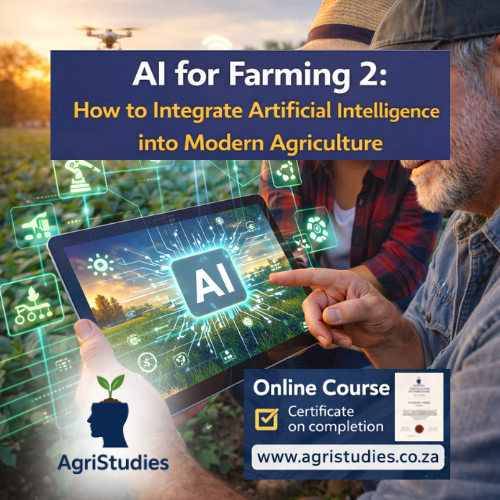
AI for Farming 2: How to Integrate Artificial Intelligence into Modern Agriculture

(2 customer reviews)

Original price was: R1450,00.Current price is: R850,00.

This AI for Farming Online Course shows how Artificial Intelligence is used in modern agriculture, from crop and livestock management to farm operations and marketing. Using real-world case studies, learners gain practical insight into precision farming, smart sensors, and data-driven decision-making for more efficient and profitable South African farms.

Website disclaimer
This programme is offered as an independent private certificate course. It is designed to provide practical, industry-aligned knowledge and skills relevant to professional application.

Description

AI for Farming 2: How to Integrate Artificial Intelligence into Modern Agriculture

Course Overview

This course introduces farmers, students, and agribusiness professionals to the practical use of Artificial Intelligence (AI) in agriculture. It focuses on real-world tools, applied case studies, and clear guidance on how AI can be integrated into everyday farming operations.

Learners are guided through the use of AI in crop production, livestock management, farm planning, and decision-making. Topics include precision farming, sensor systems, data analysis, automation, and AI-driven marketing, all explained in a practical and accessible way.

The programme is designed specifically for the South African farming environment, helping learners modernise operations, improve efficiency, reduce risk, and make better data-driven decisions using affordable and scalable AI technologies.

Language: English
Format: 100% Online (Self-Paced)
Total Duration: ±15 Hours (3 Weeks Recommended)


📘 Modules Overview
  1. Understanding Artificial Intelligence in Agriculture

  2. Precision and Smart Farming Tools

  3. Farm Data and Analytics

  4. AI for Crops

  5. AI for Livestock

  6. AI for Livestock Health, Disease Detection and Management

  7. Predictive Analytics and Decision Support

  8. Drones and Robotics in Agriculture

  9. AI for Farm Management, Accounting and Operations

  10. AI in Farm Marketing and Sales

  11. Implementing AI on Your Farm


🧠 Assessments
  • 11 Module Quizzes (10 multiple-choice questions each)

  • 1 Final Exam (50 multiple-choice questions)

  • Passing Score: 70%

  • Grading: Fully automated with instant feedback through the LMS


🎓 Certificate

Title: AI for Farming: How to Integrate Artificial Intelligence into Modern Agriculture
Issued by: Agristudies.co.za

A certificate of completion is awarded once all modules and the final exam have been successfully completed.


📦 Included in This Course
  • 100 Infographic Images explaining key AI and agricultural concepts visually

  • 100 Explanatory Video Clips providing step-by-step practical guidance


What You Will Learn

By the end of this course, learners will understand how Artificial Intelligence can be applied practically across modern farming systems.

  • Understanding how AI works within agricultural environments

  • Using precision farming tools to improve efficiency and reduce waste

  • Interpreting farm data to support better operational decisions

  • Applying AI in crop monitoring and production planning

  • Using AI tools for livestock monitoring and health management

  • Understanding predictive analytics and decision-support systems

  • Integrating automation, drones, and smart technologies responsibly

  • Improving farm administration, record keeping, and operational planning

  • Using AI to improve marketing, customer communication, and sales strategies

  • Building a realistic plan for implementing AI on a farm


Who This Course Is For

This course is suitable for:

  • Farmers wanting to modernise operations using practical AI tools

  • Farm managers responsible for planning and efficiency improvements

  • Agricultural students preparing for technology-driven farming environments

  • Agribusiness professionals working with farm data and production systems

  • Anyone interested in understanding how AI fits into modern agriculture

No advanced technical or programming experience is required.

Why This Course Stands Out

This course focuses on practical implementation rather than technical theory. Artificial Intelligence is explained in a way that makes sense for real farming environments, where decisions must be made quickly and solutions need to be reliable, affordable, and easy to apply.

Instead of presenting AI as complex or highly technical, the course shows how modern tools can be integrated into everyday farm activities such as crop monitoring, livestock management, planning, and operational decision-making. Learners gain a clear understanding of how AI supports farmers by improving efficiency, reducing risk, and helping interpret information more effectively.

The programme is designed specifically with South African farming conditions in mind, while still remaining relevant to farms globally. Emphasis is placed on scalable adoption, allowing learners to start with simple tools and expand their use of AI as their confidence and operational needs grow.

By the end of the course, learners understand not only what AI can do, but how to apply it responsibly and realistically within modern agricultural systems.

AGRISETA Accreditation is under the name Nosa Agricultural Services. Service provider code AGRI/c prov/0459/13
Course Overview

Specific Outcomes Covered in This Learner Guide

Upon completion of this course, the learner will be able to:

Specific Outcome What You Will Learn
Outcome 1 Understand the fundamentals of AI, how it works, how it differs from automation, and how learning systems use data to improve farm decision-making.
Outcome 2 Apply AI tools to improve crop production and soil management by analysing soil data, weather patterns, crop performance, and optimising fertiliser, irrigation, and pest control.
Outcome 3 Use AI systems to monitor livestock health, behaviour, and welfare using sensors, cameras, and software for early detection and better performance tracking.
Outcome 4 Implement AI-driven irrigation and resource management to reduce waste and improve sustainability through smart, sensor-based water and input application.
Outcome 5 Use AI for farm planning, forecasting, and risk management through predictive analytics for climate, market shifts, and production cycle planning.
Outcome 6 Apply AI tools to marketing, sales, and financial management by improving pricing, customer targeting, demand forecasting, and profitability tracking.
Outcome 7 Set up and use basic AI tools and applications such as AI-powered apps, sensors, and platforms, with practical examples relevant to South African agriculture.

Frequently Asked Questions

Do I need technical or programming experience to take this course?

No. The course is designed for farmers and agricultural professionals, not programmers. Artificial Intelligence concepts are explained in practical, easy-to-understand terms, with a focus on how tools are used in real farming situations. Learners are shown how to use existing AI platforms and technologies without needing coding knowledge or advanced technical skills.

Is this course only for large commercial farms?

No. The course explains AI integration at different scales, including small and medium-sized farms. Many AI tools covered are affordable and scalable, allowing farmers to start with simple applications such as data interpretation, planning assistance, or monitoring tools before expanding into more advanced systems as operations grow.

Will this course teach me how to install expensive AI equipment?

The focus is not on selling equipment or requiring expensive systems. Instead, learners are introduced to how AI works within existing farming operations and how to evaluate whether technology adds real value before investing. The course helps learners understand when technology improves efficiency and when simpler solutions may be more practical.

How does AI actually help improve farm profitability?

AI supports profitability by improving decision-making and reducing uncertainty. Examples include better crop monitoring, earlier identification of livestock health concerns, improved planning based on data patterns, and more efficient resource use. The course explains how small improvements in efficiency and risk reduction can lead to better long-term financial outcomes rather than promising unrealistic automation.

What You Will Learn

What You’ll Learn

✅ Understand what Artificial Intelligence is — and how it can transform everyday farming operations.

✅ Install and operate smart sensors, drones, and GPS tools for crops and livestock.

✅ Collect, clean, and analyse farm data to make better management decisions.

✅ Use AI to optimize irrigation, fertiliser use, and disease control in crops.

✅ Apply AI systems for livestock health, feeding, and breeding management.

✅ Read and act on AI-generated forecasts for weather, yields, and markets.

✅ Integrate AI into farm accounting, stock management, and record-keeping.

Course Structure

Course Structure

11 Core Modules

11 Module Quizzes (auto-graded, 10 questions each)

Final Exam: 50-question multiple-choice test

Total Duration: ± 3 Weeks (≈15 Hours)

Format: 100% Online — Self-Paced Learning

Languages: English

Who Should Enroll

Who Should Enrol

Farmers, farm managers, and agri-entrepreneurs

Agricultural advisors and co-op leaders

Students interested in AgriTech and farm automation

Anyone wanting to modernise their farming operations

Course Overview

Specific Outcomes Covered in This Learner Guide

Upon completion of this course, the learner will be able to:

Specific Outcome What You Will Learn
Outcome 1 Understand the fundamentals of AI, how it works, how it differs from automation, and how learning systems use data to improve farm decision-making.
Outcome 2 Apply AI tools to improve crop production and soil management by analysing soil data, weather patterns, crop performance, and optimising fertiliser, irrigation, and pest control.
Outcome 3 Use AI systems to monitor livestock health, behaviour, and welfare using sensors, cameras, and software for early detection and better performance tracking.
Outcome 4 Implement AI-driven irrigation and resource management to reduce waste and improve sustainability through smart, sensor-based water and input application.
Outcome 5 Use AI for farm planning, forecasting, and risk management through predictive analytics for climate, market shifts, and production cycle planning.
Outcome 6 Apply AI tools to marketing, sales, and financial management by improving pricing, customer targeting, demand forecasting, and profitability tracking.
Outcome 7 Set up and use basic AI tools and applications such as AI-powered apps, sensors, and platforms, with practical examples relevant to South African agriculture.

Frequently Asked Questions

Do I need technical or programming experience to take this course?

No. The course is designed for farmers and agricultural professionals, not programmers. Artificial Intelligence concepts are explained in practical, easy-to-understand terms, with a focus on how tools are used in real farming situations. Learners are shown how to use existing AI platforms and technologies without needing coding knowledge or advanced technical skills.

Is this course only for large commercial farms?

No. The course explains AI integration at different scales, including small and medium-sized farms. Many AI tools covered are affordable and scalable, allowing farmers to start with simple applications such as data interpretation, planning assistance, or monitoring tools before expanding into more advanced systems as operations grow.

Will this course teach me how to install expensive AI equipment?

The focus is not on selling equipment or requiring expensive systems. Instead, learners are introduced to how AI works within existing farming operations and how to evaluate whether technology adds real value before investing. The course helps learners understand when technology improves efficiency and when simpler solutions may be more practical.

How does AI actually help improve farm profitability?

AI supports profitability by improving decision-making and reducing uncertainty. Examples include better crop monitoring, earlier identification of livestock health concerns, improved planning based on data patterns, and more efficient resource use. The course explains how small improvements in efficiency and risk reduction can lead to better long-term financial outcomes rather than promising unrealistic automation.

2 reviews for AI for Farming 2: How to Integrate Artificial Intelligence into Modern Agriculture

  1. Pieter Goosen (verified owner) –

    Great Course

  2. Professor Jabulani Khanyile –

    Hi would I register for AI Integrate into morden agriculture for 2026

Add a review

Your email address will not be published. Required fields are marked *